The Ultimate Pre-Med Roadmap: High School to Med School Acceptance
You've just declared yourself "pre-med," and suddenly everyone has advice. Your biology teacher says to shadow 100+ hours. Your cousin who's in med school warns you about organic chemistry. Reddit tells you that without research publications, you're doomed. Meanwhile, you're sitting there thinking: Where do I even start?
Here's the truth: The pre-med path isn't confusing because you're not smart enough—it's confusing because nobody gives you the complete roadmap. Most students stumble through college collecting random activities, stressing about every B+, and realizing senior year that they missed critical steps.
I've spent years working with pre-med students, and I've seen the pattern: those who succeed don't just work harder—they work smarter with a clear plan. This guide is that plan. By the time you finish reading, you'll know exactly what to do freshman year versus senior year, which experiences actually matter to admissions committees, and how to build an application that tells a compelling story rather than just checking boxes.
This is comprehensive—it'll take about 15 minutes to read. But those 15 minutes could save you from years of wasted effort, unnecessary stress, and the heartbreak of rejection that comes from simply not knowing the game you're playing. Let's get started.
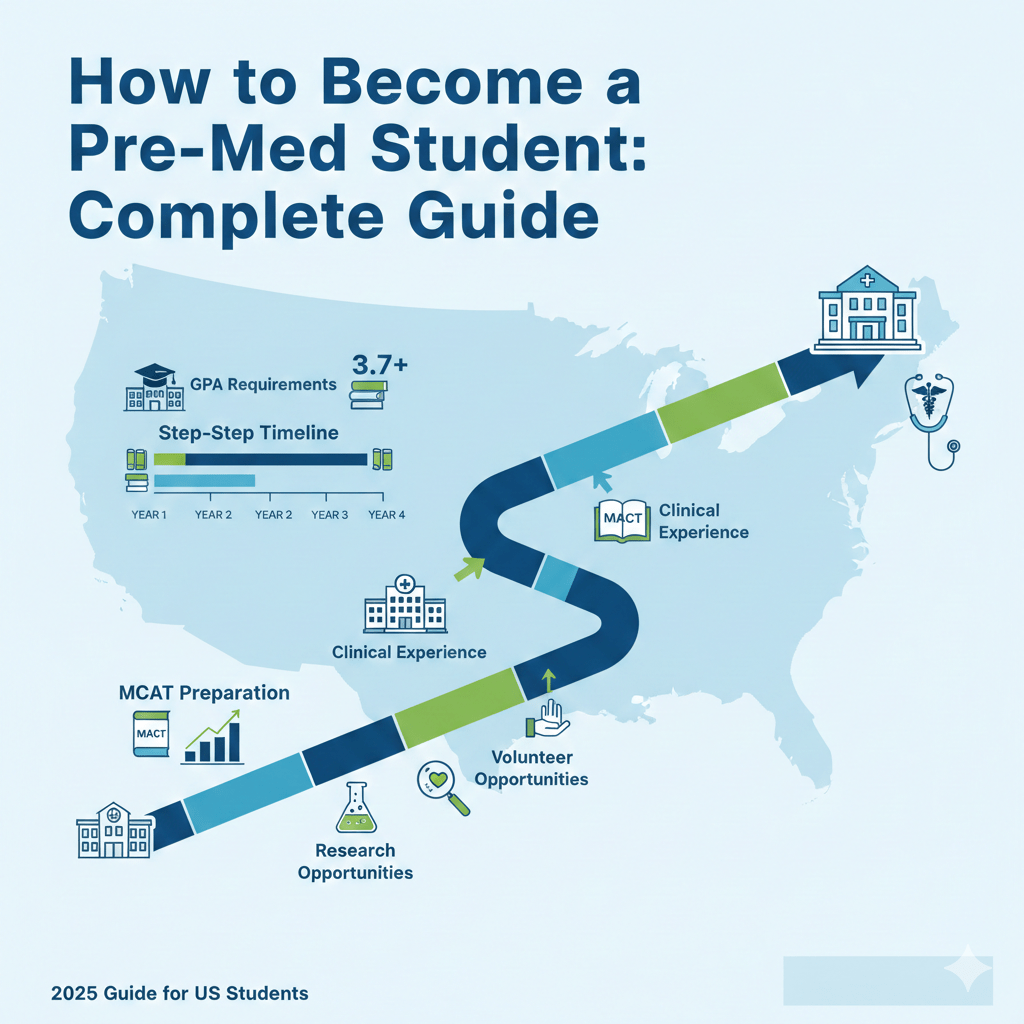
If you're still new to the pre-med journey, read this complete beginner guide first: How to Become a Pre-Med Student (A Step-by-Step Guide).What Is the Pre-Med Track? (And What "Pre-Med" Really Means)
Let's clear up the biggest misconception right away: Pre-med is not a major.
When you tell people you're "pre-med," you're describing your intention to attend medical school—not your academic concentration. You can major in biology, English, economics, dance, or mechanical engineering and still be pre-med. The label simply means you're completing the prerequisites required for medical school admission while building the experiences and skills that make you a competitive applicant.
So what do medical schools actually look for? The AAMC (Association of American Medical Colleges) evaluates applicants on 15 Core Competencies, but they boil down to four main pillars:
- Academic excellence: Strong GPA and MCAT scores proving you can handle medical school's rigor
- Clinical exposure: Direct patient care experience showing you understand what being a physician actually entails
- Service orientation: Volunteering that demonstrates genuine commitment to helping others
- Personal qualities: Leadership, resilience, communication skills, and a compelling reason for pursuing medicine
Notice what's missing? There's no requirement to cure cancer, publish in Nature, or volunteer in 47 countries. Med schools want competent, compassionate future physicians who've proven they can succeed academically while genuinely caring about patient welfare.
The key milestones from high school to acceptance look like this: build a strong academic foundation → complete medical school prerequisites with a competitive GPA → gain meaningful clinical experience → prepare for and excel on the MCAT → craft a compelling application → ace your interviews → receive that acceptance.
This guide will walk you through every single step.
Who Should Become a Doctor? How to Know If Medicine Is Right for You
Before we dive into GPAs and MCAT scores, let's talk about the most important question: Should you actually become a doctor?
I'm asking this not to discourage you, but because the students who succeed in medicine are those who choose it for the right reasons. The path is too long, too expensive, and too demanding to pursue unless you're genuinely called to it.
Ask yourself these questions honestly:
Do you find fulfillment in directly helping people through their most vulnerable moments? Can you handle the reality that you'll witness suffering, deliver bad news, and sometimes lose patients despite your best efforts? Are you intellectually curious about how the human body works and why it breaks down? Can you commit to 7-11 years of training after college (4 years medical school + 3-7 years residency) before you're a fully independent physician?
Here's what separates "I like science" from "I should be a doctor": Loving biology class is great, but loving patient care is essential. If you're fascinated by organic chemistry reactions but feel uncomfortable talking to sick people, research or pharmaceutical development might be a better fit than clinical medicine. If you love the idea of helping people but hate the thought of studying for another decade, consider becoming a PA or nurse practitioner—equally valuable healthcare careers with less training time.
Consider these alternative healthcare paths if you're uncertain:
- Physician Assistant (PA): 2-3 years of graduate school, significant clinical autonomy, better work-life balance
- Nurse Practitioner (NP): Can specialize, prescribe medications, often more flexible schedules
- Pharmacist: Deep medication expertise, patient counseling, diverse career settings
- Dentist: Procedural skills, often run own practice, more predictable hours
- Physical Therapist: Directly improve patients' function and quality of life, rewarding patient relationships
There's no shame in exploring medicine and deciding it's not for you. In fact, that's wisdom—and it's better to realize it sophomore year than after six figures of medical school debt. The rest of this guide assumes you've done this soul-searching and are committed to the path. Now let's talk about how to walk it successfully.
The High School Pre-Med Roadmap (Grades, Activities, and Early Planning)
If you're in high school and already thinking about medicine, you're ahead of the game. While you can absolutely become a doctor without any high school preparation, starting early gives you two massive advantages: you'll arrive at college with better academic habits and you'll have already explored whether medicine genuinely interests you.
What classes should you take in high school?
Focus on building a strong foundation in:
- Biology and Chemistry: Take AP versions if available and if you can maintain an A or B
- Mathematics: Complete through Pre-Calculus at minimum; Calculus is even better
- Physics: At least one year; AP Physics helps prepare you for college physics
- English and Writing: Med schools want excellent communicators—writing skills matter more than most students realize
Here's the thing about AP classes: Quality beats quantity. Four AP classes with all As and Bs is better than seven APs with Cs and Ds. Med schools will see your high school transcript during verification, and while they don't calculate a formal high school GPA, a pattern of academic struggle raises red flags.
Best extracurriculars for future pre-med students:
You don't need to be performing open-heart surgery at age 16. Instead, focus on activities that demonstrate three things: leadership, service, and genuine interest in healthcare.
- Clinical exposure: Volunteer at a hospital, shadow your family doctor, volunteer at a nursing home
- Service: Tutor younger students, volunteer at food banks, participate in community health fairs
- Leadership: Hold officer positions in clubs, captain a sports team, start a health awareness initiative at your school
The difference between volunteering and shadowing (this confuses everyone): Volunteering means you're doing something—helping patients, delivering meals, filing paperwork. Shadowing means you're observing a physician's workday. Both matter, but they serve different purposes. Volunteering shows service commitment; shadowing proves you understand what doctors actually do.
Common high school mistakes that hurt future med school applications:
Getting a C in high school chemistry and thinking "I'll just retake it in college"—college versions are much harder. Padding your résumé with activities you don't care about—admissions committees can smell inauthenticity from miles away. Burning out before you even reach college—medicine is a marathon, not a sprint. Choosing a college solely based on prestige without considering pre-med support systems.
If you're reading this in high school: take challenging courses, explore healthcare through volunteering or shadowing, and develop study habits that will serve you in college. If you're already in college: don't stress about what you didn't do in high school. The real game starts now.
College Pre-Med Overview: What You Must Do From Year 1 to Year 4
Here's what separates accepted medical school applicants from the thousands who get rejected: They understand that becoming a competitive applicant is a four-year project, not a senior-year scramble.
According to AAMC's 2024 data, only 41% of medical school applicants receive acceptance anywhere. The average accepted student has a 3.73 GPA and 511.9 MCAT score—but remember, that's an average. Half of accepted students score below those numbers, and holistic admissions means your entire application package matters.
What defines a "strong" pre-med applicant today?
Strong applicants have checked every box competently: competitive GPA (typically 3.5+), solid MCAT score (508+ for MD, 500+ for DO), meaningful clinical experience (200-500+ hours), consistent volunteering (150+ hours), and at least one or two activities showing depth and leadership. They've also developed a clear narrative connecting their experiences to their "why medicine."
Notice I said "competently," not "perfectly." You don't need a 4.0 GPA, 528 MCAT, and published research. You need to prove you can handle medical school's academic rigor while demonstrating genuine commitment to patient care and service.
How early should you start preparing?
The honest answer: Freshman fall. Not because you need to be volunteering at hospitals and studying for the MCAT immediately, but because your GPA starts counting from day one, and bad grades freshman year are nearly impossible to overcome.
Start with academics first semester. Get those study habits locked down. Join one or two clubs. Explore clinical volunteering spring semester or sophomore year. You have time—but you don't have time to waste.
The real timeline looks like this:
Freshman and sophomore years: Build GPA foundation, complete prerequisites, start clinical exposure and volunteering. Junior year: Continue activities, take MCAT (spring or summer), prepare primary applications. Senior year: Submit applications, complete secondaries, interview, and receive acceptances. Many students also take a gap year after college to strengthen applications or because they applied late—this is increasingly common and not a negative.
Let's break down each step in detail.
Choose the Right College for Pre-Med Success
Does college prestige matter for med school? Short answer: Less than you think.
Medical schools practice holistic admissions, and while coming from Harvard or Stanford might give you a slight edge, a 3.8 GPA from a state university beats a 3.3 from an Ivy League school every time. Admissions committees care more about what you accomplished than where you attended.
That said, not all colleges are created equal for pre-med students. Look for these features when choosing:
- Strong pre-med advising: Does the school have dedicated pre-health advisors who help with course planning, MCAT prep, and application strategy?
- Grade inflation vs deflation: Some schools are notorious for weeding out pre-meds with brutal curves. Research average GPAs and talk to current pre-med students.
- Research opportunities: Are there labs actively recruiting undergrads, or is research reserved for graduate students?
- Nearby hospitals and clinics: Clinical experience is essential—can you easily access volunteering and shadowing opportunities?
- Strong MCAT scores: What's the average MCAT for pre-meds from this school? This indicates quality of preparation and resources.
The community college question: Can you complete prerequisites at community college and still get into medical school? Yes—but strategically. Some medical schools don't accept community college credits for prerequisites, while others do. If cost is a factor and you're considering community college, plan to complete your bachelor's at a four-year university and retake or take upper-level science courses there to prove you can handle university-level rigor.
The best college for you is one where you can earn a high GPA, access clinical experiences, receive strong advising, and graduate with minimal debt. Prestige is nice; success is better.
Pick the Best Pre-Med Major (Science vs. Non-Science)
Let's kill the myth: There is no "best" pre-med major.
Biology is the most popular choice—about 60% of medical students majored in biological sciences—but that's because of overlap with prerequisites, not because med schools prefer it. English majors, psychology majors, engineering majors, and music majors all get accepted to medical school every year.
Can you major in psychology, business, or English and still get accepted? Absolutely, as long as you complete the required prerequisites. In fact, non-science majors can sometimes stand out in a sea of biology majors, especially if they can articulate how their unique perspective enriches their understanding of medicine.
Here's how to choose your major strategically:
Pick something you genuinely enjoy and can excel in. A 3.8 GPA in history beats a 3.3 in biochemistry. Your major classes will likely be easier for you than prerequisites you're less interested in, which helps boost your overall GPA. Consider overlap—biology, chemistry, and biochemistry majors naturally complete most prerequisites through major requirements, while English majors need to strategically fit in two years of science courses.
How med schools evaluate course rigor:
They want to see you challenged yourself academically, but not at the expense of your GPA. Taking upper-level science courses beyond prerequisites (immunology, genetics, physiology) shows intellectual curiosity and prepares you for medical school content. However, piling on impossibly hard courses and earning Cs helps nobody.
Red flags to avoid: Never take prerequisites pass/fail (medical schools require letter grades for prerequisites). Don't take suspiciously easy versions of required courses (online organic chemistry from an unaccredited institution looks terrible). Avoid massive grade discrepancies between major courses and prerequisites (4.0 in art history but 2.5 in sciences suggests you can't handle medical school).
Choose a major you love, challenge yourself appropriately, and excel. Your passion and GPA will speak louder than your major's name.
Pre-Med Course Requirements (Complete Prerequisite Checklist)
Every medical school has prerequisite requirements—courses you must complete before matriculation. While specific requirements vary slightly by school, here's the standard list:
Required prerequisites (virtually all medical schools):
- Biology with lab: 2 semesters (General Biology, often including genetics, cell biology, molecular biology)
- General Chemistry with lab: 2 semesters
- Organic Chemistry with lab: 2 semesters
- Physics with lab: 2 semesters (algebra-based acceptable at most schools)
- Mathematics: 1-2 semesters (typically through Calculus I, some schools accept statistics)
- English/Writing: 2 semesters (composition, literature, or writing-intensive courses)
Increasingly required or highly recommended:
- Biochemistry: 1 semester (now required at many schools and essential for MCAT success)
- Psychology: 1 semester (heavily tested on MCAT)
- Sociology: 1 semester (also tested on MCAT)
- Statistics: 1 semester (useful for research and understanding medical literature)
Recommended courses that boost MCAT and application strength:
Take these if you have room in your schedule: genetics, anatomy and physiology, microbiology, immunology, cell biology, molecular biology. These courses both prepare you for MCAT content and give you deeper science knowledge for interviews and medical school.
How to plan your 4-year schedule without destroying your GPA:
Never take more than two lab sciences per semester—the workload is brutal and tank-worthy. Space out your hardest prerequisites. Many students take General Chemistry freshman year, Organic Chemistry sophomore year, and Physics junior year. This prevents overload and gives you time to recover if you struggle in one course.
Complete prerequisites by spring of junior year at the latest—you need them finished before taking the MCAT. Front-load humanities and easier courses early to boost your GPA before the hardest science courses hit. Leave room for retakes. If you get a C in Organic Chemistry, you might want to retake it or take additional upper-level chemistry courses to prove competency.
The strategic approach: Map out all four years during freshman orientation with your pre-med advisor. Plug in prerequisites first, major requirements second, and electives last. Build in buffer semesters where you take lighter loads. Expect adjustments—life happens, and flexibility is essential.
How to Maintain a Competitive Pre-Med GPA
Let's talk numbers. What GPA do you actually need for medical school?
For MD (allopathic) schools, the average accepted applicant has a 3.73 cumulative GPA and 3.66 science GPA. For DO (osteopathic) schools, averages run slightly lower: 3.56 cumulative and 3.48 science. But here's what those numbers don't tell you: Plenty of students with 3.4-3.6 GPAs get accepted every year, especially with strong MCAT scores and compelling applications.
Medical schools calculate two GPAs: your cumulative GPA (all courses) and your science GPA or BCPM (Biology, Chemistry, Physics, Math courses only). Both matter, but science GPA matters more—it's the best predictor of whether you can handle medical school's science-heavy curriculum.
Best study strategies for "weed-out" pre-med classes:
Here's the reality: Organic Chemistry, Physics, and upper-level biology courses aren't designed to be easy. They're meant to filter out students who can't handle rigorous science. You don't need to be naturally brilliant—you need to be strategic.
- Start studying on day one: Don't wait for the first exam. Review notes after every lecture. The students who fail are those who cram.
- Use active learning: Passive reading doesn't work. Do practice problems, teach concepts to classmates, create your own examples.
- Go to office hours: Professors and TAs give away exam hints, explain confusing concepts, and remember students who show initiative (hello, future letter writers).
- Study groups are gold: Form a group of 3-4 serious students. Explain concepts to each other. The person who teaches learns most.
- Past exams are treasure: If professors provide old exams, use them religiously. They reveal question styles and commonly tested concepts.
How to recover from bad grades without panicking:
You got a C in Organic Chemistry. You're devastated. You think your medical school dreams are over. Breathe. A single C won't destroy your application—a pattern of Cs will.
Here's your recovery plan: First, figure out what went wrong. Was it poor study habits? Too many commitments? Personal issues? Address the root cause. Second, prove it was an anomaly. Earn As in subsequent science courses, especially upper-level ones. If you got a C in Orgo I, acing Orgo II or Biochemistry shows you learned from the mistake. Third, consider retaking if necessary. Some students retake courses where they earned Cs—both grades appear on your transcript, but it demonstrates commitment to mastery.
GPA damage control strategies:
If you're a freshman or sophomore with a sub-3.5 GPA, you still have time. Raise your game now. Take easier course loads. Drop courses early if you're struggling (a W is better than a C). If you're a junior with a 3.2 and you've already taken most prerequisites, focus on crushing the MCAT—a 515+ can partially offset a lower GPA. Consider a post-bacc or Special Master's Program (SMP) after graduation to prove you can handle graduate-level coursework.
The key is this: Don't let one bad semester define your application. Med schools value resilience and improvement more than perfection.
Clinical Experience for Pre-Meds (What Counts and How to Start)
Here's a conversation I've had hundreds of times:
Student: "I volunteered in a hospital gift shop for 100 hours. Does that count as clinical experience?"
Me: "Did you interact with patients?"
Student: "No, I sold candy bars and magazines."
Me: "Then no, it doesn't count."
What is clinical experience? Medical schools define it as any experience where you directly interact with patients in a healthcare setting. You need to be close enough to see, smell, and engage with sick or injured people. You should witness suffering, treatment, and recovery.
Best clinical jobs for pre-med students:
These are paid positions that provide excellent clinical exposure while helping you earn money:
- Medical Scribe: Follow a physician, document patient encounters, learn medical terminology and clinical workflows (15-20 hours/week typical)
- Emergency Medical Technician (EMT): Provide pre-hospital care, make quick decisions, see acute medicine (requires certification course, typically 120-150 hours)
- Certified Nursing Assistant (CNA): Provide direct patient care in hospitals or nursing homes, assist with bathing, feeding, mobility (requires certification course, typically 75 hours)
- Medical Assistant: Take vitals, prepare patients for exams, assist in clinics (certification helpful but not always required)
- Phlebotomist: Draw blood, interact with anxious patients, work in labs or hospitals (requires certification, typically 40-80 hours training)
How many clinical hours do you need? There's no magic number, but here's the general guidance: Minimum viable for acceptance is about 100-150 hours. Competitive applicants typically have 200-500+ hours. Top-tier applicants often exceed 1,000 hours, especially if they've worked as scribes or EMTs.
What matters more than raw hours is consistency and depth. Two hundred hours as an EMT spread over two years with meaningful reflections beats 50 random hours at five different clinical sites. Med schools want to see sustained commitment, not box-checking.
How to write clinical experience descriptions for AMCAS/AACOMAS:
When you fill out your application, you'll describe each experience in 700 characters or less. The formula: What you did + What you learned + Why it mattered.
Weak description: "I volunteered in the ER and helped patients."
Strong description: "Assisted ER nurses with patient intake, vitals, and transport over 250 hours across 18 months. Witnessed acute trauma care, end-of-life discussions, and the emotional toll on families. Learned that excellent bedside manner—explaining procedures calmly, listening actively—matters as much as clinical skill. One patient told me I made her feel 'seen' during the worst day of her life. That moment solidified my commitment to patient-centered care."
See the difference? Specific tasks, emotional insight, connection to why medicine.
Start your clinical experience sophomore year if possible. By junior year, you should be consistently volunteering or working in a clinical role. By application time, you'll have the hours and the stories that make your "why medicine" authentic and compelling.
Shadowing Doctors (How to Find, Schedule, and Document It)
Shadowing is exactly what it sounds like: You follow a physician around for a day (or several days), observing their work without actively participating. You're a fly on the wall watching patient appointments, procedures, rounds, and the unglamorous parts like charting and insurance paperwork.
How many shadowing hours do you need? Most students aim for 40-100 hours total across multiple specialties. You don't need 500 hours—shadowing is about exposure and confirmation that medicine is right for you, not about racking up hours.
What specialties should pre-meds shadow? At minimum, shadow primary care (family medicine or internal medicine) to understand the foundation of patient care. Then explore 2-3 other specialties that interest you: emergency medicine, surgery, pediatrics, psychiatry, OB/GYN, or others. This breadth shows you've explored medicine thoughtfully.
Cold email templates + outreach strategies that actually work:
Finding shadowing is the hardest part. Most students know zero physicians. Here's how to get your foot in the door:
Start with your own doctors. Your family physician, dentist, or specialist already knows you and is more likely to say yes. Ask your university's pre-med advising office—they often maintain lists of physicians open to shadowing. Join pre-med clubs that organize shadowing opportunities. Cold email physicians whose work interests you.
Here's an email template that works:
Subject: Pre-Med Student Shadowing Request
Dear Dr. [Name],
My name is [Your Name], and I'm a [year] at [University] pursuing medicine. I'm particularly interested in [specialty] because [specific, genuine reason—maybe you read about their research, or you're interested in the patient population they serve].
I would be honored to shadow you for a day or half-day to learn more about your work and the realities of [specialty]. I'm available [list specific days/times] and happy to work around your schedule.
I understand patient privacy and would sign any necessary HIPAA forms. Thank you for considering my request.
[Your name, email, phone]
Send 10-15 of these. Expect 1-3 responses. Follow up once after a week. Don't be discouraged by silence—physicians are busy, and it's not personal.
Shadowing mistakes that make you look unprofessional:
Showing up late or in inappropriate clothing (business casual is safe: no jeans, no sneakers). Being on your phone during patient encounters. Asking patients invasive questions or acting like you know more than you do. Forgetting to send a thank-you email afterward. Treating shadowing like a passive experience where you just stand there—ask thoughtful questions during downtime, take mental notes, reflect on what you learned.
Document every shadowing experience with the physician's name, specialty, dates, hours, and key takeaways. You'll need this for applications and interviews. And when you interview for medical school, you'll be asked: "Tell me about a meaningful patient encounter you observed while shadowing." Have specific stories ready.
Volunteering That Impresses Med Schools (Service + Mission Fit)
Medical schools don't just want future doctors—they want future doctors who genuinely care about serving their communities. Volunteering proves you're motivated by service, not just salary and prestige.
There are two types of volunteering that matter: clinical volunteering (interacting with patients in healthcare settings) and non-clinical volunteering (community service unrelated to healthcare). You need both.
Clinical volunteering ideas:
Hospital volunteer programs (patient transport, ER greeter, discharge assistance), free clinics for uninsured patients, health fairs providing screenings or education, hospice volunteering, camp counselor for kids with chronic illnesses, Ronald McDonald House family support.
Non-clinical volunteering ideas:
Tutoring underserved students, food bank or soup kitchen shifts, Habitat for Humanity builds, crisis hotline counseling, ESL teaching for immigrants, mentoring at-risk youth, environmental cleanup projects, Special Olympics coaching.
How to choose meaningful service experiences:
Ask yourself: Does this align with my values? Will I learn something about the community I want to serve? Can I commit long-term? One-off volunteer days look like résumé padding. Sustained commitment to one or two causes over years demonstrates genuine service orientation.
For example: Volunteering every Saturday morning at a homeless shelter for two years teaches you about healthcare access barriers, builds relationships with a vulnerable population, and shows dedication. Volunteering once at 15 different events shows you're checking boxes.
Aim for 100-150+ hours of non-clinical volunteering by application time. Like clinical experience, depth and consistency matter more than raw hours. And here's the secret: Choose volunteering that genuinely moves you. If you care about refugee health, volunteer with refugee resettlement. If you're passionate about childhood obesity, volunteer with youth fitness programs. Your authenticity will shine through in your essays and interviews.
One final note: Volunteering abroad or medical mission trips are controversial. They can be meaningful if done responsibly with established organizations and ongoing commitment. They can be exploitative if you're treating patients without training or parachuting in for Instagram photos. If you go this route, be prepared to thoughtfully discuss what you learned about global health disparities and cultural humility.
Research for Pre-Meds (Do You Really Need It?)
The question I get most: "Do I need research to get into medical school?"
Short answer: No, especially if you're applying to non-research-focused MD programs or DO schools.
Longer answer: Research strengthens your application and is virtually required for top-tier research institutions (think Harvard, Johns Hopkins, UCSF). If you're aiming for competitive schools or considering academic medicine as a career, research is essential.
How to find research opportunities as a freshman or sophomore:
Most universities have undergraduate research programs. Start by searching your school's website for "undergraduate research" or "UROP." Email professors whose work interests you—read their recent publications first, then send a thoughtful email explaining why their research excites you and asking about openings. Attend research fairs where labs recruit students. Join honor societies or pre-med organizations that connect students with research mentors.
Types of research:
- Wet lab / basic science research: Working in a biology, chemistry, or biochemistry lab studying cellular mechanisms, drug development, or disease pathways
- Clinical research: Working with physician-researchers studying patient outcomes, treatment effectiveness, or health interventions—often involves data analysis and patient recruitment
- Public health / epidemiology research: Studying population-level health trends, health policy, or disease prevention
- Social science research: Studying health behaviors, medical education, healthcare access, or patient experiences
All types "count." Choose based on your interests and what's available. If you hate bench work, don't force yourself into a wet lab.
Posters, publications, and how to describe your role honestly:
Here's what research accomplishments mean in med school admissions:
- Lab experience with no output: Still valuable—you learned research methodology, critical thinking, and lab techniques
- Poster presentation at a conference: Great addition showing you contributed meaningfully to a project
- Co-authorship on a publication: Excellent, even if you're 5th author—publications are rare for undergrads
- First authorship: Exceptional and rare—major boost to your application
Be honest about your contributions. If you ran Western blots and analyzed data, say that. Don't claim credit for designing the study if you just pipetted samples. Admissions committees interview thousands of students—they can tell when someone's exaggerating.
Most competitive applicants have 1-2 years of research with a poster or publication. If you have neither, compensate with exceptional clinical experience and a compelling narrative about pursuing clinical medicine over academic research.
The bottom line: Research is helpful but not required unless you're targeting top-tier programs. Dedicate your time where it matters most for your goals. A thousand hours of meaningful clinical work beats 200 hours of begrudging lab work you hated.
Leadership, Awards, and "Stand-Out" Extracurriculars
Leadership matters to medical schools because physicians lead healthcare teams, mentor students, and advocate for patients. But leadership doesn't mean you need to be student body president or varsity team captain. Medical schools define leadership broadly: initiating projects, mentoring others, solving problems, or creating change.
What leadership looks like in a med school application:
President or officer of a campus organization (pre-med society, volunteer club, cultural organization), peer tutor or TA for challenging science courses, shift supervisor at your clinical job, founder of a health initiative or awareness campaign, team leader for a research project, mentor for younger pre-med students, organizer of a fundraiser or community event.
Notice these aren't all formal titles. If you noticed your campus lacked mental health resources and organized peer support groups, that's leadership. If you trained new EMTs and created an improved onboarding process, that's leadership.
Best clubs/organizations for pre-med leadership roles:
Join organizations aligned with your interests: Alpha Epsilon Delta (pre-health honor society), free clinic volunteering groups, global health organizations, cultural pre-med groups (SNMA, LMSA, etc.), research clubs, health policy advocacy groups.
Quality over quantity: Holding officer positions in 1-2 clubs where you made meaningful impact beats being a passive member of 10 clubs. Depth and longevity impress admissions committees.
National vs. campus awards: what makes a difference?
National awards are impressive but rare. Think Goldwater Scholarship, Fulbright, NIH research funding, published research awards. If you have these, great—they're significant boosts.
Campus awards matter too: Dean's List, departmental honors, research presentation awards, scholarship recipients. These show recognition of your excellence.
But here's the truth: Most accepted medical students don't have prestigious awards. If you don't have any, it's not disqualifying. Focus your energy on activities that build experiences and skills rather than chasing awards.
The goal isn't to have a perfect résumé—it's to demonstrate you're a capable, compassionate person who takes initiative and makes a difference. Show that through your activities, and the rest will follow.
When and How to Start MCAT Prep (The Smart Timeline)
The MCAT (Medical College Admission Test) is a 7.5-hour beast testing biology, chemistry, physics, psychology, sociology, critical reasoning, and reading comprehension. Your MCAT score is the second-most important factor in admissions after GPA, and unlike your GPA, you get multiple chances to improve it.
When should you take the MCAT?
The ideal timeline: Take the MCAT in spring or early summer of your junior year (or the year before you plan to apply). This gives you time to retake if needed and still apply that same cycle. Many students also take gap years and test after graduation—this is increasingly common and allows more prep time.
How long should you study for the MCAT?
Most successful students study 3-6 months depending on their baseline and schedule. Students with strong prerequisite knowledge might need 3-4 months of dedicated study (15-20 hours/week). Students who need content review or haven't taken prerequisites recently should plan for 4-6 months. Those studying while taking full course loads might extend to 6+ months at lower weekly hours.
Here's what doesn't work: cramming for 6 weeks. Data shows students who study for 3+ months score on average 8-12 points higher than those who rush. The MCAT isn't a memorization test—it's reasoning and application. You need time for your brain to integrate concepts.
Best MCAT prep resources:
- UWorld: Gold standard for practice questions—comprehensive, difficult, excellent explanations (expensive but worth it)
- AAMC Official Materials: Created by test makers, most representative of actual exam—use these for final month
- Kaplan or Princeton Review Books: Solid content review, good for building foundation
- Anki Decks: Spaced repetition flashcards—Premed95, AnKing, or MileDown popular choices
- Khan Academy: Free MCAT content, especially good for psychology/sociology
- Jack Westin: Free daily CARS (Critical Analysis and Reasoning) passages
MCAT schedule example (3-month plan):
Month 1: Content review using Kaplan/Princeton books, create Anki cards, start UWorld (15-20 hours/week). Month 2: Continue UWorld, take first half-length practice exam, identify weak areas, focused content review (20-25 hours/week). Month 3: Full-length practice exams every weekend, review wrong answers extensively, AAMC materials exclusively final 2 weeks (25-30 hours/week).
The most important MCAT study principle: Spend 2x as long reviewing wrong answers as you did taking the test. A 4-hour practice exam should be followed by 8 hours of review. This is where real learning happens.
Target scores: For top MD programs, aim for 515+. For most MD programs, 508-512 is competitive. For DO programs, 500-505 is average. But remember—your MCAT must be balanced with your GPA. A 510 MCAT with 3.8 GPA is stronger than 518 with 3.3 GPA for most schools.
How to Build Your Pre-Med Application Narrative (Your "Why Medicine")
Every medical school application and interview comes down to one question: Why do you want to be a doctor?
"I want to help people" is what everyone says. "I love science" is generic. "My grandmother died of cancer" can work, but only if you connect it to genuine insight about medicine, not just grief.
Your application narrative is the thread connecting all your experiences into a coherent story that answers: What specific experiences showed you what medicine entails? What did you learn about yourself, patients, and healthcare? Why is being a physician—specifically—the right path for you?
Turning experiences into a strong story:
Let's say you volunteered in an ER for 200 hours. The weak narrative: "I volunteered in the ER and saw doctors help people, which inspired me."
The strong narrative: "During my ER volunteering, I met Maria, a diabetic patient who visited monthly for blood sugar crises. She couldn't afford insulin consistently. Watching Dr. Chen spend extra time explaining generic options, connecting her with patient assistance, and calling pharmacies showed me that excellent medicine isn't just diagnosis—it's understanding social barriers to health. This experience drove me to volunteer at a free clinic and shadow at a Federally Qualified Health Center, where I learned that physicians serve as advocates for vulnerable patients. I want to practice in underserved communities where I can combine clinical expertise with systems-level thinking to address health disparities."
See the difference? Specific patient, specific doctor, specific insight, connected to future actions and career goals.
How to avoid cliché pre-med personal statements:
Avoid these overused angles unless you have a genuinely unique take: "I want to help people" without specifics, "I love science" as your only reason, "My relative got sick" without reflection on what you learned, "I shadowed and was inspired" without describing what specifically inspired you, "Medicine combines science and service" (every applicant knows this).
Instead, dig deeper. What specific moment changed your understanding of medicine? What patient interaction revealed something about yourself? What surprised you about clinical work? What makes you angry about healthcare? Your authentic reflections—even uncomfortable ones—make compelling narratives.
Letters of Recommendation (LORs) That Get You Taken Seriously
Letters of recommendation can make or break your application. Generic letters from famous professors who barely know you hurt more than strong letters from lesser-known teachers who know you well.
Who should write your med school letters?
Most schools require:
- 2 science faculty (biology, chemistry, physics professors)
- 1 non-science faculty (humanities, social science professor)
- 1-2 additional letters (PI from research, clinical supervisor, physician you shadowed)
Some schools accept committee letters (one letter from your university's pre-med committee summarizing all evaluations). Some schools have specific requirements—always check MSAR (Medical School Admissions Requirements) for each school.
How many letters do you need?
AMCAS allows up to 10 letters, but most students submit 4-6 total. More isn't better if they're weak. Quality over quantity.
How to request letters (with timeline + what to give your writers):
Start building relationships with potential letter writers sophomore and junior years. Go to office hours regularly. Ask thoughtful questions. Do excellent work in their classes. Engage in their research or volunteer programs.
Timeline: Request letters at least 2-3 months before you need them (typically spring of junior year for applications). Professors are busy—give them time.
The request email should include:
A polite ask: "I'm applying to medical school and would be honored if you'd write me a strong letter of recommendation. I valued your class and appreciate your mentorship."
Context: Brief summary of your grades in their courses, your involvement in their lab/program, why their letter matters.
Materials to help them write: Your résumé/CV, unofficial transcript, draft personal statement, list of schools you're applying to, specific experiences or qualities you hope they'll highlight, deadline and submission instructions.
Meet with them in person if possible. Remind them of specific instances where you demonstrated qualities med schools value: intellectual curiosity, resilience, teamwork, compassion.
Follow up 2-3 weeks before the deadline politely. After they submit, send a handwritten thank-you note and update them on your acceptances later—professors love seeing students succeed.
The Med School Application Process Explained (AMCAS, AACOMAS, TMDSAS)
The application process is complex, expensive, and time-consuming. For a full step-by-step breakdown of AMCAS, secondaries, interviews, and school selection, read: How to Get Into Medical School (The Ultimate Guide for Applicants).But understanding the system helps you navigate it strategically.
What is AMCAS? The American Medical College Application Service is the centralized application for most MD (allopathic) medical schools. You submit one primary application, and it's sent to every MD school you select.
What is AACOMAS? The American Association of Colleges of Osteopathic Medicine Application Service is the centralized application for DO (osteopathic) medical schools.
What is TMDSAS? The Texas Medical and Dental Schools Application Service is the separate application system for Texas public medical schools (MD and DO).
MD vs. DO: What's the difference and which should you apply to?
MD (Doctor of Medicine) and DO (Doctor of Osteopathic Medicine) are both fully licensed physicians who can practice any specialty, prescribe medications, and perform surgery. The main differences: DOs receive additional training in osteopathic manipulative treatment (OMT), a hands-on approach to diagnosis and treatment. DO schools have slightly lower average GPA/MCAT requirements. DO schools emphasize primary care and underserved populations (though DO graduates match into all specialties).
Apply to both if: Your stats are in the DO range (3.4-3.6 GPA, 500-506 MCAT), you're interested in primary care or rural medicine, you want to maximize acceptance odds.
Primary application timeline (month-by-month):
May: AMCAS and AACOMAS open for submission. Start entering coursework, activities, and essays.
June: Submit primary applications as early as possible (early June is ideal). Applications are verified (takes 2-6 weeks), so early submission = earlier consideration.
July-October: Schools send secondary applications as they review primaries. Complete secondaries within 2 weeks of receiving them—quick turnaround shows interest.
September-March: Interview invitations arrive. Interview season runs all year, but most interviews occur October-February.
October-May: Acceptances, waitlists, and rejections roll out. Many schools use rolling admissions, so earlier is better.
Secondary applications: how to write them fast and well:
Every school sends secondaries—additional essays specific to their program. Common prompts include: "Why our school?" "Describe a challenge you overcame," "Tell us about a time you worked in a team," "Discuss diversity/healthcare disparities."
Pre-write answers to common prompts before secondaries arrive. When you receive secondaries, customize your pre-written answers to each school. Research each school's mission, curriculum, location, and unique programs. Mention specific details: "I'm drawn to University of X's longitudinal integrated clerkship model and Health Equity Scholars Program."
Aim to complete each secondary within 1-2 weeks. Schools track how long you take—delayed secondaries suggest lack of interest.
Med School Interviews (MMI vs. Traditional) + How to Prepare
Congratulations—if you've received interview invitations, you're already in the top 10-20% of applicants. Now you need to seal the deal.
What do med schools look for in interviews?
They're assessing: Can you communicate clearly and compassionately? Do you handle stress and ethical dilemmas thoughtfully? Are you self-aware and reflective? Do you demonstrate professionalism and maturity? Does your personality match their program's culture?
Common med school interview questions:
"Tell me about yourself / Walk me through your journey to medicine." "Why do you want to be a doctor?" "Why our school specifically?" "Tell me about a time you failed / faced conflict / worked in a team." "What's your greatest weakness?" "Where do you see yourself in 10 years?" "How would you handle [ethical scenario]?" "What's the biggest problem facing healthcare today?" "Tell me about a meaningful clinical experience."
Best response frameworks:
Use the STAR method for behavioral questions: Situation, Task, Action, Result. Be specific with examples. Show reflection—what did you learn?
For ethical scenarios, think aloud. There's rarely one "right" answer. Show you consider multiple perspectives, patient autonomy, and ethical principles.
MMI tips: How to handle ethical scenarios + station timing:
Multiple Mini Interviews (MMI) involve 6-10 short stations (usually 7-8 minutes each) with different interviewers or scenarios. Stations might include: traditional interview questions, ethical dilemmas, teamwork exercises, role-play scenarios (consoling a friend, breaking bad news).
MMI strategy: Take 30 seconds to think before responding. You have limited time, so be concise but thoughtful. For ethical dilemmas, acknowledge complexity: "This situation involves balancing patient autonomy with beneficence..." Show empathy in role-play stations. In teamwork stations, listen actively and contribute ideas.
What to wear + interview etiquette:
Conservative business professional: Suit (dark blue or gray), closed-toe shoes, minimal jewelry, neat hair, light makeup if any. For virtual interviews, same rules apply—dress professionally head to toe (you might stand up), neutral background, good lighting, test technology beforehand.
Arrive 15 minutes early. Turn off your phone. Make eye contact. Firm handshake. Be polite to everyone—administrative staff, students, other applicants. Send thank-you emails within 24-48 hours to interviewers (if you have contact info).
Common Pre-Med Challenges (And How to Overcome Them Without Losing Your Mind)
Let's talk about the reality nobody mentions in glossy medical school brochures: The pre-med path is grueling, and at some point, you'll struggle.
Pre-med burnout: causes, warning signs, solutions
Burnout symptoms include: chronic exhaustion despite sleep, cynicism toward medicine, decreased academic performance, withdrawal from activities you once enjoyed, anxiety or depression, physical symptoms (headaches, stomach issues).
Causes: Trying to do everything perfectly, comparing yourself to others constantly, neglecting self-care, lack of boundaries between school and life, imposter syndrome.
Solutions: Give yourself permission to be human. You don't need a 4.0, 528 MCAT, and 1000 volunteer hours. Take at least one day per week completely off from studying. Exercise, sleep 7-8 hours, maintain friendships outside pre-med circles. Consider therapy—most universities offer free counseling. If you're truly burned out, taking a semester off or gap year isn't failure—it's wisdom.
Time management for pre-meds:
You can't do everything simultaneously at 100%. During MCAT prep, your GPA maintenance, clinical hours, and research might drop. During heavy course loads, you might volunteer less. This is normal.
Use time-blocking: Designate specific hours for specific tasks. Protect study time but also protect rest time. Learn to say no—you don't need to join every club or attend every event. Batch similar tasks (all your pre-med advising appointments in one week, all your shadowing emails sent at once).
How to handle rejection, imposter syndrome, and comparison culture:
Every pre-med feels like everyone else has it together except them. This is the comparison trap, amplified by social media. Truth: The student who posts their 520 MCAT probably doesn't post about their 3.2 GPA. The one who brags about their publication might be struggling clinically.
Rejection is inevitable—from research positions, volunteering programs, even medical schools. A "no" often isn't about your worth; it's about fit, timing, or factors beyond your control. Build resilience by maintaining perspective: One rejection doesn't define your future. Learn what you can, adjust, and keep going.
Imposter syndrome—feeling like you don't belong or aren't good enough—affects nearly every pre-med, especially those from underrepresented backgrounds. Combat it by collecting evidence of your competence: save positive feedback, track your accomplishments, surround yourself with supportive people who remind you of your capability.
What to do if you're "behind" in the pre-med timeline:
Maybe you're a junior who just decided on medicine. Maybe you failed Organic Chemistry. Maybe you took two gap years after a health crisis. You're not behind—you're on your own timeline.
Medicine attracts non-traditional students: career-changers, parents, veterans, people who discovered medicine late. Many successful physicians didn't follow the traditional path. Focus on what you can control now. If you're a junior starting clinical experience, work intensively to accumulate hours before applying. If you failed a class, retake it and prove you've grown. If you need gap years, use them productively.
There's no prize for finishing fastest. There's only the goal of becoming an excellent, compassionate physician. Take the time you need.
Pre-Med Roadmap by Year (Complete Checklist)
Let's break down exactly what you should accomplish each year. Use this as a guide, not gospel—adjust based on your circumstances.
Freshman Year Pre-Med Checklist:
- Declare pre-med intent and meet with pre-health advisor within first month
- Enroll in General Biology and General Chemistry (with labs)
- Focus on building strong study habits and earning high grades (GPA>3.6 goal)
- Join 1-2 pre-med clubs or organizations; attend meetings regularly
- Start exploring clinical exposure: hospital volunteer applications, shadowing inquiries
- Build relationships with professors: attend office hours, ask questions
- Maintain social life and self-care—avoid burnout before you even start
Sophomore Year Pre-Med Checklist:
- Continue prerequisites: Organic Chemistry, Physics (space them out if possible)
- Begin consistent clinical volunteering (hospital, clinic, or paid position like scribing)
- Start shadowing physicians in 1-2 specialties
- Continue non-clinical volunteering in causes you care about
- Consider research opportunities: email professors, attend research fairs
- Take on leadership role in one organization
- Build relationships with potential letter writers
- Start preliminary MCAT content review (Anki, casual reading)
Junior Year Pre-Med Checklist:
- Complete remaining prerequisites including Biochemistry, Psychology, Sociology
- Intensive MCAT prep: 3-6 months of dedicated study
- Take MCAT in spring or early summer (allows retake time if needed)
- Continue and deepen clinical and volunteer experiences (aim for consistency)
- Request letters of recommendation from professors and clinical supervisors
- Attend medical school fairs; research school lists (MD vs. DO, mission fit)
- Draft personal statement over summer
- Begin primary applications immediately when AMCAS/AACOMAS open (June)
Senior Year Pre-Med Checklist (Applications + Gap Year Planning):
- Complete secondary applications promptly (July-October)
- Prepare for and attend interviews (September-March)
- Continue meaningful activities—schools may ask for updates
- Make gap year plans if not applying this cycle: clinical job, research position, or post-bacc
- Send thank-you notes after interviews
- Respond to acceptances, waitlists, rejections thoughtfully
- Choose your medical school by April 30 (or whenever deposit is due)
- Graduate, celebrate, prepare for medical school transition
Gap Year Considerations: Many students take 1-2 gap years intentionally. This isn't falling behind—it's strategic. Gap years allow you to: work full-time in clinical roles, strengthen applications if you applied unsuccessfully, save money, mature personally, avoid burnout before medical school's intensity.
Gap Year Strategy: Should You Take One Before Medical School?
Taking a gap year (or two) between college and medical school is increasingly common. In fact, over 60% of medical school matriculants take at least one gap year. Let me be clear: This isn't a backup plan for weak applicants—it's often a smart strategy for strong ones.
When a gap year helps:
You want to strengthen your application (improve GPA through post-bacc, gain more clinical hours, retake MCAT). You applied late or unsuccessfully and need to reapply. You're burned out and need time to recharge before medical school's intensity. You want to save money by working full-time before taking on debt. You want to explore your interests more deeply (research, global health, public health work). You want life experience and maturity before committing to a decade of training.
When a gap year is unnecessary:
You're a strong applicant applying on time with competitive stats, experiences, and compelling essays. You're energized and ready for the next academic challenge. You have funding secured and aren't concerned about working beforehand.
Best gap year jobs for med school applicants:
Clinical positions (medical scribe, EMT, CNA, medical assistant, clinical research coordinator), research positions (lab technician, research assistant), AmeriCorps or Teach for America (service + leadership), public health roles (health department, NGO), post-bacc programs if you need to raise GPA or complete prerequisites.
How to apply while working full-time:
It's doable but requires discipline. Block time evenings/weekends for secondaries and interview prep. Request time off for interviews—most employers understand. Save money for application costs ($2,000-5,000+ for full cycle). Use vacation days strategically for interview travel.
Taking a gap year doesn't delay your medical career—it often strengthens it. You'll arrive at medical school more mature, financially stable, and certain of your path.
Conclusion
You've made it through this comprehensive roadmap—from high school exploration through medical school acceptance. That's the span of 4-8 years distilled into one guide. Let me bring it all together.
Becoming a doctor isn't about being perfect. It's about being persistent, strategic, and genuinely committed to patient care. You now have a complete plan: Build a strong GPA through smart studying and course planning. Gain meaningful clinical experience that teaches you what medicine really entails. Volunteer consistently in causes that matter to you. Shadow physicians across specialties to confirm your path. Prepare intensively for the MCAT and score competitively. Craft an application that tells your unique story authentically. Interview with confidence and professionalism.
The students who get accepted aren't the ones who did everything flawlessly—they're the ones who stayed the course despite setbacks, learned from mistakes, and never lost sight of why they wanted this in the first place. There will be moments you doubt yourself. You'll face organic chemistry exams that humble you, MCAT practice tests that discourage you, and rejection that stings. This is normal. Every physician sitting in every hospital right now experienced those exact moments. What separates them? They kept going.
Here's what I want you to do next: Don't try to implement everything tomorrow. Instead, identify where you are in this roadmap right now. High school student? Focus on building academic foundation and exploring clinical volunteering. College freshman? Lock in those study habits and start building relationships with professors. Sophomore or junior? Time to get serious about clinical hours and MCAT prep. Senior or post-grad? You're in application mode—execute your plan with precision.
Pick one action from this guide and do it this week. Email a physician about shadowing. Sign up for hospital volunteer orientation. Schedule a meeting with your pre-med advisor. Start your MCAT content review spreadsheet. Draft the opening paragraph of your personal statement. Small actions compound into medical school acceptance.
And here's my ask: What's your biggest pre-med challenge or fear right now? Drop it in the comments below. I read and respond to every single one, and chances are your question will help dozens of other students who share the same worry but haven't voiced it. Let's build a community of pre-meds who support each other through this journey.
You've got this. The path is long, but it's walkable—and you don't have to walk it alone.
Frequently Asked Questions (FAQs)
How early should I start preparing for medical school?
You should start planning and building awareness as early as high school if you're interested—taking rigorous science courses, exploring clinical volunteering, and shadowing doctors. However, serious application-building happens in college. The critical years are freshman through junior year of undergrad, when you complete prerequisites, build your GPA, accumulate clinical hours, and prepare for the MCAT. If you're a senior or recent grad, it's not too late—gap years are common and strategic.
What GPA is competitive for med school acceptance?
For MD schools, the average accepted applicant has a 3.73 cumulative GPA and 3.66 science GPA (according to 2024 AAMC data). For DO schools, averages run slightly lower: 3.56 cumulative and 3.48 science GPA. However, these are averages—many students with 3.4-3.6 GPAs get accepted with strong MCAT scores, compelling experiences, and excellent applications. Below 3.3 becomes challenging for MD programs, but DO schools and post-bacc programs remain options. GPA isn't everything in holistic admissions, but it's your foundation.
How many clinical hours do I need for med school?
There's no magic number, but here's general guidance: Minimum viable is 100-150 hours of direct patient contact. Competitive applicants typically have 200-500+ hours. Top-tier applicants often exceed 1,000 hours, especially if they've worked as medical scribes, EMTs, or CNAs for a year or more. What matters more than raw hours is consistency, depth, and meaningful reflection on what you learned. Two hundred hours as an EMT over two years with thoughtful insights beats 500 random hours at five different hospitals with no clear takeaways.
Is the MCAT harder than college science classes?
The MCAT tests differently than college exams. It's less about pure memorization and more about reasoning, application, and passage analysis. Many students find CARS (Critical Analysis and Reasoning) the hardest section because it's pure logic and reading comprehension—no studying can fully prepare you if you struggle with reading quickly and analytically. The science sections require content knowledge but emphasize understanding over memorization. Compared to college, the MCAT demands different skills: stamina (7.5 hours), test-taking strategy, and integrated thinking across disciplines. With proper preparation (3-6 months of dedicated study), most students can score competitively.
Can I get into med school without research experience?
Yes, absolutely—especially if you're applying to non-research-focused MD programs or DO schools. Research strengthens applications and is virtually required for top-tier institutions like Harvard, Johns Hopkins, or UCSF, but most medical schools prioritize clinical experience and service over research. If you have strong clinical hours (scribing, volunteering, shadowing), meaningful community service, solid academics, and a compelling "why medicine," you can gain acceptance without research. However, if you have the opportunity and interest, research adds depth to your application, teaches critical thinking, and opens doors to academic medicine careers.