I've watched friends nail a 3.9 GPA and still get rejected. I've seen students with mediocre stats but incredible patient stories land multiple acceptances. The whole process is part strategy, part luck, and part proving you actually know what you're signing up for when you say you want to be a doctor.
This isn't one of those sanitized "follow these ten steps" guides. Medical school admissions is messy, subjective, and honestly kind of brutal. But if you understand how the system actually works—not how it's supposed to work in theory—you can navigate it without losing your mind or your savings account.
What Medical Schools Actually Care About (Beyond Your GPA)
Everyone fixates on grades. And yeah, your GPA matters—a lot. But here's what trips people up: medical schools aren't just looking for smart people. They're looking for smart people who can prove they won't burn out, freak out, or bail out halfway through intern year when they're working 80-hour weeks and questioning every life decision.
That's why your transcript is just the starting point.
The Academic Baseline Nobody Wants to Admit
The typical accepted student has around a 3.7 overall GPA and roughly 3.65 in science courses [Source: AAMC, recent data]. Top programs? You're looking at 3.9+ territory.
Medical schools calculate two separate GPAs, by the way—your overall average and your science GPA, which includes only biology, chemistry, physics, and math courses. If there's a big gap between these numbers, it raises flags. A 3.8 overall with a 3.3 science GPA suggests you're great at humanities but struggle when things get technical. Not exactly what admissions committees want to see.
The courses you need are pretty standard across schools:
- Biology with lab (2 semesters)—usually general biology plus upper-level courses like genetics or cell biology
- General Chemistry with lab (2 semesters)
- Organic Chemistry with lab (2 semesters)—the course that makes pre-meds reconsider their life choices
- Physics with lab (2 semesters)
- Biochemistry (1 semester)—increasingly a hard requirement, not just "recommended"
- Math (typically calc and stats)
- English/writing (2 semesters)
- Behavioral sciences (psychology and sociology are heavily tested on the MCAT now)
Some schools throw in extras—ethics courses, specific biology electives, even foreign language at a few places. Check individual school requirements early, because discovering senior year that you needed an extra course is a nightmare.
The MCAT: Your Academic Proving Ground
The MCAT is a 7.5-hour endurance test that covers everything from organic chemistry to sociology to reading comprehension. Scores range from 472 to 528. The average accepted student scores around 511 [Source: AAMC].
Competitive range? You want at least 510, ideally 515+ for top programs.
The test has four sections, each scored 118-132:
- Chemical and Physical Foundations of Biological Systems
- Critical Analysis and Reasoning Skills (basically an intense reading comp section)
- Biological and Biochemical Foundations of Living Systems
- Psychological, Social, and Biological Foundations of Behavior
What admissions committees look for: balance. A 515 with one section at 125 and the others at 130 looks worse than a 512 with all sections around 128. They want to see you can handle every domain, not just excel in your comfort zone.
Mapping Out Your Undergrad Years (Without Burning Out by Sophomore Spring)
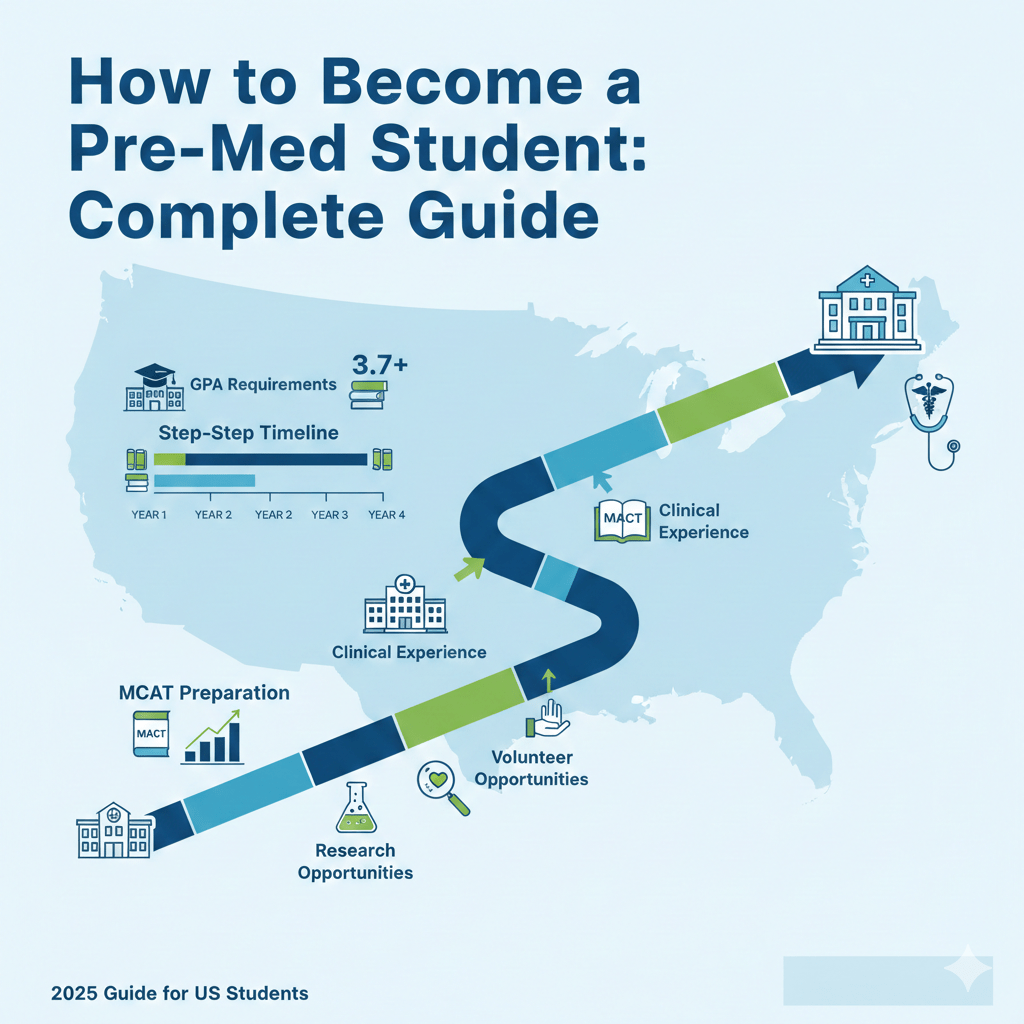
Here's a realistic timeline that won't destroy you:
For a full step-by-step timeline starting from high school (not just college), see: The Ultimate Pre-Med Roadmap: High School to Med School Acceptance.
| Year | Academic Focus | Extracurriculars | What Nobody Tells You |
|---|---|---|---|
| Freshman | Gen chem, intro bio, calc | Join pre-med clubs, start shadowing | Your GPA this year sets your baseline—don't blow it off thinking you have time to recover |
| Sophomore | Organic chem, physics | Begin regular clinical volunteering (aim for weekly commitment) | This is the weed-out year. Organic chemistry humbles everyone. Get a tutor early, not after your first exam. |
| Junior | Upper-level sciences, biochem | Heavy clinical hours, leadership roles, MCAT prep (spring) | This is your application-building year. Everything you do now goes on your application. Also, you'll be exhausted. |
| Senior | Finish any missing prerequisites, maybe some fun electives | Submit applications (June), write secondaries (summer), interviews (fall/winter) | If you're applying right after junior year, summer before senior year is brutal—secondaries, interview prep, and trying to have a life. |
This assumes you're applying immediately after junior year.“This assumes you're applying immediately after junior year, which only works if you’ve already built a strong foundation during your early college years as a pre-med student.”
About 60% of accepted students take at least one gap year, which honestly relieves a lot of pressure.
Your Major: Pick Something You Won't Hate
Roughly half of med school applicants major in biological sciences. But here's the kicker—acceptance rates tell a different story [Source: AAMC]:
- Humanities majors: ~48% acceptance rate
- Physical sciences: ~46%
- Biological sciences: ~41%
- Social sciences: ~44%
Non-science majors actually have slightly better odds. Why? A few theories. One, they stand out in a sea of biology majors. Two, students tend to perform better in subjects they actually enjoy, leading to higher GPAs. Three, admissions committees genuinely value diverse perspectives.
Plus, if you decide halfway through college that you don't want to be a doctor after all (and plenty of students do), a non-science major gives you actual career options beyond "I guess I'll apply to grad school?"
Bottom line: Major in something you find genuinely interesting. A 3.8 in English beats a 3.3 in Biology every single time.
Clinical Experience: Proving You Know What You're Getting Into
Medical schools are obsessed with one question: does this applicant actually understand what being a doctor involves, or did they just watch too much Grey's Anatomy?
That's why clinical experience is non-negotiable. Shadowing is observation. Clinical work is participation. You need both, but hands-on experience carries more weight.
Most competitive applicants have 150-300 hours minimum. Top applicants? Often 500+.
Ways to Actually Work With Patients
EMT or Paramedic: This is probably the most intensive option. You complete a certification course (usually 120-150 hours of training), then work part-time or during summers. You're doing real patient care—transporting people, performing basic life support, seeing medical emergencies. It's chaotic and often disturbing, which is exactly why it's valuable.
Medical Scribe: You shadow physicians and document everything in their electronic health records. It's a paid position, you learn medical terminology rapidly, and you see clinical decision-making up close. The downside? You're glued to a computer, not interacting directly with patients as much.
Certified Nursing Assistant (CNA): This involves direct patient care—bathing, feeding, taking vitals, helping people to the bathroom. It's unglamorous work. It's also some of the most intimate patient interaction you can get. Medical schools respect it because it shows you're willing to do the hard, uncomfortable parts of healthcare.
Hospital Volunteering: The easiest to access but also the least hands-on. You might transport patients, deliver supplies, or sit with families in waiting rooms. It counts, but it's not as compelling as paid clinical work.
Clinical Research Coordinator: If you're working on studies involving patients—recruiting participants, collecting data, coordinating procedures—it bridges both clinical exposure and research experience.
Make It Mean Something
Here's where students mess up: they treat clinical hours like a checkbox. They volunteer for exactly 150 hours, write "interacted with diverse patient populations" on their application, and call it done.
Admissions committees see through this instantly.
What they want: specific stories. Not "I volunteered at a hospital for 200 hours." More like "I spent six months in the pediatric oncology ward, and one afternoon a 9-year-old girl asked me why some people survive cancer and others don't, and I had to figure out how to have that conversation without training or authority, just human connection."
Keep a journal. Write down patient interactions that stuck with you. Document what surprised you, what challenged you, what made you more certain (or less certain) about medicine. These become your interview stories and personal statement material. (Internal link: "How to document clinical experiences for medical school applications")
Research: Not Required, But Often Expected
Research is weird. Officially, most medical schools say it's "optional." In practice, if you're applying to top academic medical centers, about 90% of accepted students have research experience.
If you want to practice community medicine and have zero interest in academia? You can probably skip extensive research. But if you're eyeing places like Johns Hopkins, UCSF, or Washington University, you need a research story.
How to Actually Get Research Experience
Email professors directly. Find faculty whose work interests you. Read one or two of their recent papers so you can reference them specifically. Send a concise email: "I'm a sophomore biology major interested in your work on X. I have 10-15 hours per week to contribute to your lab. Would you have space for an undergraduate researcher?"
Most professors appreciate motivated students. You'll probably start with menial work—cleaning equipment, organizing data, running errands. That's fine. Over time, you work your way up to substantive contributions.
Apply to formal summer programs. Programs like NIH Summer Internship, Amgen Scholars, or university-specific research programs offer stipends and structured mentorship. They're competitive but worth applying to.
Clinical research at hospitals. Contact research coordinators at local hospitals. Clinical research gives you both research experience and patient exposure, which is efficient.
Making Research Count
One meaningful project beats three superficial experiences.
Aim to:
- Present at a conference (poster or oral presentation)
- Co-author a publication (even if you're fifth author)
- Develop your own project or thesis
- Understand your work deeply enough to defend it in an interview
Because here's what happens: you list research on your application, and interviewers will grill you. "What was your hypothesis? What methods did you use? What were your results? What do they mean clinically?" If you stammered through pipetting for six months without understanding the bigger picture, it'll be obvious.
Leadership and Service Beyond Healthcare
Medicine requires more than scientific knowledge. Physicians lead teams, advocate for patients, navigate hospital politics, and serve communities.
Medical schools assess leadership through your activities, not titles. Being president of a club you barely participated in means nothing. Being a committed member who organized a major fundraiser means something.
Service That Actually Matters
Aim for 50-100 hours of non-clinical volunteering. Choose causes you genuinely care about:
Community health outreach: Volunteer at free clinics, organize health fairs, teach nutrition classes at community centers. This connects to medicine without being purely clinical.
Work with underserved populations: Tutor low-income students, serve meals at homeless shelters, teach ESL to immigrants. These experiences show commitment to serving vulnerable communities, which is a huge theme in medicine.
Sustained commitment over scattered one-offs: Volunteering every Saturday for two years at one organization crushes 15 different one-time events. Admissions committees want to see depth and dedication.
Leadership Worth Listing
Seek positions where you actually accomplished something:
- Organized a fundraiser that raised $8,000 for pediatric cancer research
- Led pre-med society to increase membership by 150%
- Captained a sports team through a challenging season
- Mentored incoming freshmen through a formal program
- Started a new campus organization addressing an unmet need
Document specific accomplishments. "Served as treasurer" is boring. "Managed a $15,000 budget and increased club funding by 40% through new fundraising initiatives" shows impact.
Conquering the MCAT Without Losing Your Mind
Plan for 300-350 hours of total study time spread over 3-6 months. That's substantial—basically a part-time job.
Months 1-2: Content Review
Systematically review all tested subjects. Use the AAMC content outline as your roadmap. Take notes on weak areas. Complete practice problems after each topic.
Months 3-4: Practice and Application
Take full-length practice tests weekly. Review every missed question thoroughly—understanding why you got something wrong matters more than the score itself. Focus study time on weak sections.
Months 5-6: Refinement
Take practice tests under timed, test-day conditions. Focus exclusively on official AAMC materials now. Work on pacing and test-taking strategies.
Resources That Actually Work
AAMC Official Materials (these are essential):
- Official Guide to the MCAT
- Practice Exams (there are 11 total)
- Section Bank questions
- Question Packs
Third-Party Prep:
- Kaplan MCAT Complete 7-Book Subject Review
- Princeton Review MCAT Subject Review
- UWorld MCAT Question Bank (this is gold for practice)
Take at least 5-7 full-length practice exams before test day. Your practice scores typically predict your actual score within 3-5 points.
When to take it: Most students take the MCAT spring of junior year. This gives you time to retake if necessary before applications open in June.
Retaking: Schools see all your scores but usually focus on your highest or most recent. Retake if your score falls 5+ points below your practice average. Don't retake for a 1-2 point increase—it's not worth it.
Writing a Personal Statement That Doesn't Sound Like Every Other One
You get 5,300 characters (about one page) to answer one question: Why medicine?
Every applicant writes some version of "I want to help people and I love science." You need to be more specific, more personal, and more honest.
Start With Something Real
Skip generic openings about childhood dreams or family expectations.
Weak: "I have always wanted to be a doctor. Medicine combines my passion for science with my desire to help people."
Stronger: "The patient in bed 12 was dying, and everyone knew it except her. Stage IV pancreatic cancer, maybe weeks left. I was volunteering in the oncology unit, delivering meals, when she asked me to sit with her while she ate. For twenty minutes, we talked about her grandchildren, her garden, the azaleas blooming outside her window. She never mentioned cancer. I realized then that medicine isn't just about treating disease—it's about preserving humanity in the face of it."
The stronger version puts the reader in a specific moment with sensory details and emotional weight.
Structure That Works
Part 1—The Hook (2-3 paragraphs): Open with a meaningful experience that sparked your interest. Include specific details and dialogue.
Part 2—Development (3-4 paragraphs): Show how your understanding of medicine deepened. Connect multiple experiences. Demonstrate growth.
Part 3—What You Bring (2-3 paragraphs): Highlight qualities through specific examples. Don't claim you're "compassionate and hardworking." Show compassion through actions.
Part 4—Looking Forward (final paragraph): Articulate what kind of physician you want to become. Be specific about populations you want to serve or approaches you value.
What Kills Personal Statements
Generic language: "I want to help people" and "I love science" could describe literally any applicant.
Medical jargon: Write for a general audience. Your reader might be a philosophy professor on the admissions committee.
Listing activities: Your personal statement isn't a resume. Pick 2-3 experiences and explore them deeply.
Ignoring challenges: If you overcame significant obstacles—illness, family hardship, learning disability—address them. These show resilience.
Making it about someone else: Tell YOUR story, not your parent's journey as a physician or a patient's brave battle with cancer.
Get feedback from pre-med advisors, writing center tutors, physicians, and friends who write well. Write 5-10 drafts over several months. (Internal link: "Common personal statement mistakes pre-med students make")
Letters of Recommendation: Getting People to Actually Vouch for You
Most schools want 3-5 letters:
- Two science professors (upper-level courses preferred)
- One non-science professor
- One physician you've shadowed or worked with
- One additional letter (research mentor, supervisor, or another professor)
Some schools accept committee letters from your pre-med committee, which replaces individual letters.
Choose People Who Actually Know You
A lukewarm letter from a famous researcher destroys your application more than a glowing letter from an assistant professor helps it.
Strong letter writers:
- Taught you in small classes where you participated
- Supervised your research, clinical work, or volunteering
- Observed your growth over months or years
- Interacted with you outside formal class time
Weak letter writers:
- Taught you in a 300-person lecture where you never spoke
- Haven't seen you in 2+ years
- Know you from only one semester
- Write generic letters for dozens of students annually
Ask the Right Way
Request letters at least 3-4 months before deadlines. Do it in person or via video call when possible.
Include in your request:
"Dear Dr. Martinez,
I'm applying to medical schools this June and would be honored if you'd write a letter of recommendation. I took your Immunology course last spring and have been working in your lab for the past year on the autoimmune disease project.
Would you feel comfortable writing a strong letter on my behalf? I understand you write many letters, so I want to make sure you have adequate time.
The deadline is June 1st, though I'd appreciate receiving it by May 15th for timely submission.
I've attached my resume, transcript, and a personal statement draft to provide context. Please let me know if you need anything else.
Thank you for your mentorship this past year.
Best,
[Your Name]"
Notice the key phrase: "Would you feel comfortable writing a strong letter?" This gives them an out if they can't write enthusiastically.
Make their job easier by providing a packet with your resume, transcript, personal statement draft, list of schools, and specific experiences you shared with them.
The Application Timeline: When Everything Happens
Applications open early May through AMCAS (allopathic schools) or AACOMAS (osteopathic schools).
Critical dates:
- Early May: Applications open
- Early June: Submit primary application (do this EARLY—schools review on rolling basis)
- June-July: Receive secondary applications
- July-September: Complete secondaries
- October-March: Interview season
- October-April: Acceptance offers arrive
- April 30: Deadline to narrow to one acceptance (for schools following AAMC guidelines)
Submit your primary in early June if possible. Schools review applications on a rolling basis, so June submissions get considered before August submissions.
Building Your School List
Apply to 15-25 schools. Fewer than 15 limits your chances. More than 30 gets expensive (application fees add up fast) without substantially improving odds.
Break schools into three categories:
Reach schools (5-7): Your stats fall below their averages. Apply because you have exceptional experiences or unique qualities.
Target schools (8-12): Your stats align with their median accepted student. Reasonable chance of acceptance.
Safety schools (2-5): Your stats exceed their averages. You're a strong candidate.
Research each school:
- Average GPA and MCAT of accepted students
- Mission and values (primary care focus? Research emphasis?)
- Curriculum structure (traditional lectures vs. problem-based learning)
- Location and cost
- Where graduates match for residency
State residency matters tremendously. Public medical schools heavily favor in-state applicants. Texas residents should apply to multiple Texas schools. California residents face brutal competition but benefit from having many options.
Secondary Applications: Where Schools Actually Get to Know You
Secondaries arrive 2-8 weeks after submitting your primary. Schools use them to collect additional information and gauge your interest.
Most include:
- School-specific essays (250-500 words each)
- Diversity statements
- "Why our school?" questions
- Adversity or challenge essays
Complete secondaries within two weeks of receiving them. Fast turnaround shows organization and genuine interest.
The "Why Us?" Essay
This is where students phone it in and lose points.
Don't write: "Your school has excellent clinical training and research opportunities."
Do write: "Your Medical Humanities program aligns perfectly with my background in literature and interest in narrative medicine. I'm particularly drawn to Dr. Johnson's work on physician-patient communication, and I'd love to participate in the student-run free clinic serving the refugee community, given my experience teaching ESL."
Reference 3-4 specific elements:
- Unique curriculum features (early clinical exposure, integrated curriculum)
- Specific research opportunities in your area of interest
- Community service programs that match your background
- Faculty whose work excites you
- Patient populations you want to serve
Generic secondaries are obvious and hurt your chances.
Interview Season: Your Personality Finally Matters
Schools use three main formats:
Traditional interviews: One-on-one, 30-60 minutes, conversational. Questions about your experiences and motivations.
Multiple Mini Interviews (MMI): 6-10 short stations (8-10 minutes each). Each presents a scenario, ethical dilemma, or question. Tests critical thinking and communication under pressure.
Panel interviews: 2-4 interviewers simultaneously. Less common, more intense.
Questions They'll Definitely Ask
About motivation:
- Why medicine instead of nursing, PA, public health?
- Walk me through your journey to medicine
- What concerns you about becoming a physician?
About experiences:
- Describe a meaningful patient interaction
- Tell me about a time you failed
- What did you learn from your research?
About the school:
- Why do you want to attend here specifically?
- What questions do you have for me?
- What other schools are you considering?
Ethical scenarios:
- A patient refuses a life-saving treatment. What do you do?
- Your colleague is impaired at work. How do you respond?
- You disagree with a senior physician's decision. What's your approach?
Prep That Actually Helps
Study your application obsessively. Interviewers pull questions directly from what you wrote. Know your research hypothesis, your patient stories, your leadership accomplishments in detail.
Practice out loud. Record yourself. Watch it back. Notice filler words, nervous habits, vague explanations. Practice until answers sound natural, not rehearsed.
Research the school thoroughly. Know their curriculum, mission, special programs. Read student blogs. Understand what makes them unique.
Prepare thoughtful questions. Ask things like:
- How do students support each other in your curriculum?
- What resources exist for students struggling academically or personally?
- What clinical sites do students rotate through?
Avoid questions easily answered on their website.
Send thank-you emails within 24 hours to each interviewer. Keep them brief and genuine.
After Interviews: The Waiting Game
Acceptances arrive on a rolling basis from October through May.
Waitlists are normal. About half of accepted students were waitlisted at least one school. Waitlists clear March through August.
If waitlisted:
- Send a letter of intent to your top choice expressing strong interest
- Provide monthly updates on new accomplishments
- Stay positive and keep pursuing other acceptances
- Have a reapplication plan if needed
Once you decide on a school, decline other acceptances promptly. This opens spots for waitlisted applicants.
Gap Years: Not a Failure, Increasingly the Norm
About 60% of accepted students took at least one gap year.
Reasons to take one:
- Strengthen your application (boost clinical hours, improve MCAT, complete research)
- Gain life experience outside academia
- Work to pay down undergrad debt
- Confirm medicine is the right path
- Recharge before the intensity of medical school
Productive gap year activities:
- Clinical work (EMT, scribe, research coordinator)
- Research positions
- Teach for America or AmeriCorps
- Public health jobs
- Post-baccalaureate or master's programs (if your stats need boosting)
Application timing: Apply DURING your gap year, not after. Otherwise you take two years off instead of one.
Fixing Application Weaknesses
Low GPA (below 3.5)
This makes admission challenging but not impossible.
Options:
- Post-baccalaureate programs (formal programs for grade repair, 1-2 years)
- Special Master's Programs (graduate-level coursework alongside med students)
- Show strong upward trend (2.8 freshman year → 4.0 senior year demonstrates growth)
- Crush the MCAT (score 515+ to prove academic ability)
- Address extenuating circumstances honestly in your application
Low MCAT (below 505)
Options:
- Retake after 300+ hours of focused study
- Consider osteopathic (DO) schools, which typically accept slightly lower scores
- Take a gap year to improve your score
- Caribbean schools as absolute last resort (research carefully—high attrition, harder residency matching)
Limited Clinical Experience
Quick ways to gain hours:
- EMT certification (3-4 months training)
- Medical scribe positions (some hire with minimal training)
- Hospital volunteering (4 hours weekly adds up)
- Pharmacy technician certification
One year of consistent work (10 hours/week) = 500 hours.
Non-Traditional and Reapplicants
Non-traditional applicants (career changers, older students, parents) face unique challenges:
- Explain your timeline in your personal statement
- Take recent science courses if you graduated 5+ years ago
- Get letters from recent supervisors or professors
- Highlight maturity, life experience, and professional skills as strengths
Reapplicants (nearly half of applicants reapply at least once):
- Identify specifically why you didn't get in
- Make significant improvements (not minor tweaks)
- Apply to different schools more aligned with your stats
- Write a strong reapplicant essay explaining your growth
- Request feedback from schools that rejected you (some provide it)
Special Programs Worth Knowing About
BS/MD programs: Admit students from high school for combined bachelor's/MD (6-8 years). Extremely competitive (acceptance rates below 5%) but guarantee medical school admission.
Early Assurance programs: College sophomores apply and receive conditional acceptance to specific medical schools. Complete undergrad knowing you have a spot.
MD/PhD programs (MSTPs): Train physician-scientists (7-8 years). Full tuition coverage plus stipend at most programs. For students passionate about running their own research labs.
DO vs. MD: Both are full medical degrees with identical practice rights. DOs learn osteopathic manipulative medicine and emphasize holistic care. DO schools typically accept slightly lower stats (average MCAT ~505 vs. 511 for MD). (Internal link: "Understanding the difference between DO and MD programs")
Financial Reality Check
Medical school costs $250,000-$450,000 for four years (tuition, fees, living expenses).
Funding options:
- Merit scholarships (apply to schools where your stats exceed their averages)
- Need-based aid (complete FAFSA)
- Military programs (HPSP covers full tuition in exchange for service)
- National Health Service Corps (scholarships for serving underserved areas)
- Loan repayment programs (work in rural/underserved areas, receive $50,000-$200,000 over 2-5 years)
Average medical student debt: $200,000-$250,000.
Repayment strategies:
- Income-Driven Repayment (pay 10-15% of discretionary income)
- Public Service Loan Forgiveness (10 years at non-profit hospitals)
- Refinance after residency when earning attending salary
- Live frugally early in your career to pay down aggressively
Debt is manageable. Median physician salaries range from $200,000-$500,000+ depending on specialty. Most docs pay off loans within 5-10 years post-residency.
Quick-Hit Questions
Do I need to major in biology?
Absolutely not. Major in whatever interests you. Non-science majors actually have slightly higher acceptance rates, probably because they stand out and tend to have stronger writing skills. Just complete the prerequisite courses.
How many clinical hours do I really need?
There's no magic number, but 150-200 is a baseline. Competitive applicants often have 300-500+. More important than total hours: consistency over time. Two years of weekly shifts beats one summer of intensive hours.
Should I take a gap year?
If you need to strengthen your application, gain life experience, or confirm medicine is right for you—absolutely. Over half of accepted students take gap years now. It's increasingly normal and often makes you a stronger applicant and better student.
What if I have a low GPA but strong MCAT (or vice versa)?
One can somewhat compensate for the other. A 3.4 GPA with a 520 MCAT shows you're smart but maybe struggled early. A 3.9 GPA with a 505 MCAT suggests you work hard but struggle with standardized tests. Neither is ideal, but both are workable with strong narratives and experiences. Focus on making the rest of your application exceptional.
How many schools should I apply to?
15-25 is the sweet spot. Fewer than 15 limits your chances. More than 30 gets expensive without significantly better odds. Apply strategically—mix of reach, target, and safety schools.
You Can Actually Do This
Medical school admissions is exhausting, expensive, and emotionally draining. You'll question whether it's worth it. You'll watch friends in other fields get jobs while you're still taking prerequisites. You'll spend thousands on applications, travel, and interview prep.
But here's the truth: tens of thousands of students navigate this successfully every year. They're not all geniuses. They're not all wealthy. They're persistent, strategic, and genuinely committed.
Start early—plan your undergrad years intentionally from day one. Build genuine relationships with professors, physicians, and mentors. Gain experiences because they interest you, not just to check boxes. Write honestly and specifically about why you want this career. Prepare thoroughly for every step.
Learn from setbacks. Half of applicants get rejected initially. Many reapply and succeed. Rejection doesn't mean you're not smart enough or qualified enough—sometimes it means your application needs refinement or your school list needs adjustment.
Medicine is a career that combines intellectual challenge, human connection, problem-solving, and the privilege of being present during people's most vulnerable moments. The path is long and difficult, but for people who genuinely want it, few careers offer the same depth of impact.
Your journey starts with a single decision. Make it today.